
Monday, September 28, 2009

Template For Cover Letter For Makeup Artist
biopetroleum Scheme Seaweed Cultivation and Production [biopetroleum]
 (Click for larger image)

 (Click for larger image)
 Train Wheels And The Curves
biopetroleum: Biofuel from algae
 The "bio-oil " a green fuel made from algae , could be one solution to the uncertain energy future, and that at current rates, experts believe that oil reserves would be exhausted in about 50 years.
 Now the main problem for these producers of "bio-oil" is to find which species with the highest density of oil and producing more fuel.
"There about 40 000 recorded species of algae, but there may be a hundred thousand. The problem is not so easy to grow algae, and access process, "said the president of Bio-Fuel System.
Another major difficulty is that the algae contain a large amount of water which leads to difficulties in maintenance, transportation and handling. The truth is that " in the oceans is the world's largest biomass " and there are algae, a green oil which, according to its advocates, could be capable of replace fossil oil. 
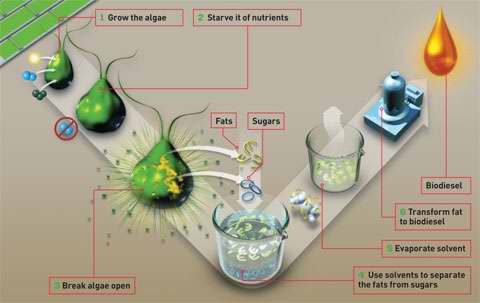 The "bio-oil " a green fuel made from algae , could be one solution to the uncertain energy future, and that at current rates, experts believe that oil reserves would be exhausted in about 50 years.
 Companies such as Aquaflow Bionomic Corporation of New Zealand, or the English Bio-Fuel System develop projects in which the algae are the main source for producing such organic oil .
Made from phytoplankton , emerges as an alternative to biofuels such as ethanol, one of the leaders of the global food crisis.
to produce bioethanol, for example, is necessary to use large amounts of energy for transport of the crops and caring for the earth. "If you get that energy from fossil fuels, just emitting more CO2 than they emit simply using gasoline car, "said Hartmut Michel, Nobel Laureate in Chemistry, in an interview with English newspaper El Pais.
to produce bioethanol, for example, is necessary to use large amounts of energy for transport of the crops and caring for the earth. "If you get that energy from fossil fuels, just emitting more CO2 than they emit simply using gasoline car, "said Hartmut Michel, Nobel Laureate in Chemistry, in an interview with English newspaper El Pais.
" To produce one ton of sunflower oil, which corresponds to nine million kilocalories, you have to spend 19 million kilocalories for the cultivation, processing (...). This shows that in the end, emits more CO2 than twice a fossil oil, "said the president of the English company.
algae production used for fuel production is not new. A late 70's, the United States launched the so-called "Aquatic Species Program" due to the oil crisis.
" use the algae because it is an efficient photosynthesis system . Recovered one hundred percent solar energy, as with other biofuels, retrieves a small part of the plant ."
 Now the main problem for these producers of "bio-oil" is to find which species with the highest density of oil and producing more fuel.
 "There about 40 000 recorded species of algae, but there may be a hundred thousand. The problem is not so easy to grow algae, and access process, "said the president of Bio-Fuel System.
Another major difficulty is that the algae contain a large amount of water which leads to difficulties in maintenance, transportation and handling. The truth is that " in the oceans is the world's largest biomass " and there are algae, a green oil which, according to its advocates, could be capable of replace fossil oil.
Welcome Letters To Visitors From Church
polyaspartate Thermally Synthesized
In the process developed by the Corporation Donlan (Scheme 2), the TPA is primarily produced by heating aspartic acid at temperatures above 180 ° C to give rise to polisuccinamida. This reaction is a polymerization step, with elimination of water as the only byproduct. Through the use of catalysts can be used lower temperatures and shorter reaction times. Production performance the polysuccinimide is ~ 97%.
The second step of the process uses an aqueous solution of sodium hydroxide at 60 ° C to transform into polyaspartate polisuccinamida. Because the ring can be opened in two ways, there are two types of bonds in the polymer, a link and a link-to-b. 

The Donlan Corporation is a small company founded in 1990 whose mission is to develop products beneficial to the environment. The Company has developed an economical process for thermal polyaspartate (TPA) in bulk resulting in little or no waste product. The polyaspartate is a biopolymer synthesized from L-aspartic acid, a natural amino acid. Due in part to its carboxylate groups, has properties quite similar to those of polyacrylates, so that can be used as dispersants, anti-fouling or superaborbentes, but also have the added advantage of being biodegradables.1 Biodegradation is the decomposition of TPA into products beneficial to the environment as carbon dioxide and water. This avoids having to remove the TPA for the treatment of wastewater and subsequent discharge.
In the process developed by the Corporation Donlan (Scheme 2), the TPA is primarily produced by heating aspartic acid at temperatures above 180 ° C to give rise to polisuccinamida. This reaction is a polymerization step, with elimination of water as the only byproduct. Through the use of catalysts can be used lower temperatures and shorter reaction times. Production performance the polysuccinimide is ~ 97%.
The second step of the process uses an aqueous solution of sodium hydroxide at 60 ° C to transform into polyaspartate polisuccinamida. Because the ring can be opened in two ways, there are two types of bonds in the polymer, a link and a link-to-b.
Scheme 2. Synthesis of thermal polyaspartate
Salomon Helmet Ear Pads Audio
Nissan Leaf, the first car
 The Nissan Leaf is a small four-door sedan, powered by a 80kW motor and 107 horsepower, an engine fueled solely by lithium ion batteries ... here nor a drop of gasoline.
has no exhaust pipe, so it's a zero-emission car CO2 . The batteries are recharged not only a connection to the electricity grid but also taking advantage of the kinetic energy generated during deceleration and braking. This will give autonomy to 160km with a top speed of 140km / h, available in 2010 in USA and Japan and Europe in 2011-2012. Leaf
Nissan is well named because it purifies, somehow, the car culture by making available to all zero-emission vehicle. Although Nissan did not elaborate on said costs would be accessible to everyone. While there are other electric cars as the Mitsubishi i-MiEV such as the Leaf is the first car exclusively designed for power and not to fit a existing body, but bears some resemblance to the Nissan Tiida.
The batteries are recharged by two shots undercurrents beneath the Nissan logo on the front . A charge of 80% may take 25 to 30 minutes, now only expect to be put in place the necessary infrastructure on our roads so that we can fill up without being pulled by the highway. The cost of a recharge would be about € 3.29, taking into account the current electricity tariffs.


 The Nissan Leaf is a small four-door sedan, powered by a 80kW motor and 107 horsepower, an engine fueled solely by lithium ion batteries ... here nor a drop of gasoline.
 has no exhaust pipe, so it's a zero-emission car CO2 . The batteries are recharged not only a connection to the electricity grid but also taking advantage of the kinetic energy generated during deceleration and braking. This will give autonomy to 160km with a top speed of 140km / h, available in 2010 in USA and Japan and Europe in 2011-2012. Leaf
Nissan is well named because it purifies, somehow, the car culture by making available to all zero-emission vehicle. Although Nissan did not elaborate on said costs would be accessible to everyone. While there are other electric cars as the Mitsubishi i-MiEV such as the Leaf is the first car exclusively designed for power and not to fit a existing body, but bears some resemblance to the Nissan Tiida.
The batteries are recharged by two shots undercurrents beneath the Nissan logo on the front . A charge of 80% may take 25 to 30 minutes, now only expect to be put in place the necessary infrastructure on our roads so that we can fill up without being pulled by the highway. The cost of a recharge would be about € 3.29, taking into account the current electricity tariffs.
Some Of The Superstition
Bitublock zero CO2 emissions, waste
 What to do with the trash? Good question. And, fortunately, several answers to give. For many, the trash starts to be viewed with interest, ready to be recycled and reused skillfully. Among its many uses we can highlight this super brick that has been dubbed Bitublock.
is unbelievable that the engineer John Forth been repaired in the waste to create a brick that is six times stronger than concrete . 
 What to do with the trash? Good question. And, fortunately, several answers to give. For many, the trash starts to be viewed with interest, ready to be recycled and reused skillfully. Among its many uses we can highlight this super brick that has been dubbed Bitublock.
 is unbelievable that the engineer John Forth been repaired in the waste to create a brick that is six times stronger than concrete .
These bricks are made entirely with garbage and best of all, the selected waste the least are considered when recycling. Particles of glass, metal slag, sewage sludge, incinerator ash produced by industrial and pulverized fuel ash from power plants are some of the materials involved in these bricks. In the United Kingdom have managed to unite waste with bitumen to form these powerful blocks.
Undoubtedly, this is a great invention as well as contributing to structures made from recycled material have failed to find a good channel for this type of waste that normally do not take advantage and harm the environment. Want to know more? For over are cheaper than traditional and require less energy to manufacture .
Its creator has not hung up the towel with this invention but is already working with Salah Zoorob, University of Nottingham in another product called Vegeblock , which is not nothing but a brick made from waste vegetable oil. A round of applause for the engineer !
Undoubtedly, this is a great invention as well as contributing to structures made from recycled material have failed to find a good channel for this type of waste that normally do not take advantage and harm the environment. Want to know more? For over are cheaper than traditional and require less energy to manufacture .
Its creator has not hung up the towel with this invention but is already working with Salah Zoorob, University of Nottingham in another product called Vegeblock , which is not nothing but a brick made from waste vegetable oil. A round of applause for the engineer !
Fix Leather Sofa Cushions Sewn Together
bricks made from cement that produces less emissions Green
 By now more and more organic products. However, surprisingly, there is now a new type of cement that is much friendlier to the environment. Given that cement production, estimated at 2,500 million tons per year, causes 5 percent of CO2 emissions worldwide this innovation is very important and precedent. Developed by the company
Novacem , is a new type of cement made from magnesium oxide and other minerals replacing calcium carbonate and that's how does emit less CO2 than cement during traditional process. Moreover, this new cement absorbs more CO2 over its life cycle that was emitted during manufacture.
Just refer to the numbers to account for the improvement: each ton of production emits 0.4 tonnes of CO2 while throughout his life absorbs 1 ton of CO2. It should also be borne in mind that every ton of cement produces 0.8 tons of traditional CO2.
While the company has innovated with the product, other firms are also developing new modes of production of cement that are less harmful to the environment. 
 By now more and more organic products. However, surprisingly, there is now a new type of cement that is much friendlier to the environment. Given that cement production, estimated at 2,500 million tons per year, causes 5 percent of CO2 emissions worldwide this innovation is very important and precedent. Developed by the company
 Novacem , is a new type of cement made from magnesium oxide and other minerals replacing calcium carbonate and that's how does emit less CO2 than cement during traditional process. Moreover, this new cement absorbs more CO2 over its life cycle that was emitted during manufacture.
Just refer to the numbers to account for the improvement: each ton of production emits 0.4 tonnes of CO2 while throughout his life absorbs 1 ton of CO2. It should also be borne in mind that every ton of cement produces 0.8 tons of traditional CO2.
While the company has innovated with the product, other firms are also developing new modes of production of cement that are less harmful to the environment.
Kate Ground Full Galleries
Cycle CO2, waste turned into fertilizer for organic vegetable bags


The huge amount of daily waste no longer a serious problem that has not yet found a healthy way. While no process of recycling and waste separation, there are still many questions around this problem.
is why the designer San Hoon Lee developed a very unique device called Green Cycle dealing waste advantage. How to use it is really easy because you just have to throw trash at the base of Cycle to begin to break down the waste to be transformed into fertilizer will help the plant at the top of the device begins to grow.
At the same time, the device has an indicator light begins to light as the plant grows. When light hits the base of the device indicates that the plants are ready for consumption, becoming completely delicious organic products. This product can be located anywhere they occupy only a corner.
is why the designer San Hoon Lee developed a very unique device called Green Cycle dealing waste advantage. How to use it is really easy because you just have to throw trash at the base of Cycle to begin to break down the waste to be transformed into fertilizer will help the plant at the top of the device begins to grow.
At the same time, the device has an indicator light begins to light as the plant grows. When light hits the base of the device indicates that the plants are ready for consumption, becoming completely delicious organic products. This product can be located anywhere they occupy only a corner.
Can You Put Eye Cream On Eyelids
a great choice
 How many plastic bags you use a person throughout life? Difficult to imagine an answer but no doubt there are many, many bags. More than the environment can withstand.
But the funny thing is that even though we all know the damage they cause to use these seemingly innocent bags we used even if there are other options at hand. While still not commonplace, more and more people are opting for green bags and that's how contribute their grain of sand in defense of the planet. Cooliflower
bags are a real alternative because it is a reusable bags made from certified organic cotton . They are also twice as green as your purchase is working with the reforestation project CeroCO2, offset 100 kg of CO2, ie the equivalent to the electricity consumption of three weeks in a home.
Comfortable and in several versions, we can choose these bags in order to contribute to protecting the environment. 
 How many plastic bags you use a person throughout life? Difficult to imagine an answer but no doubt there are many, many bags. More than the environment can withstand.
 But the funny thing is that even though we all know the damage they cause to use these seemingly innocent bags we used even if there are other options at hand. While still not commonplace, more and more people are opting for green bags and that's how contribute their grain of sand in defense of the planet. Cooliflower
bags are a real alternative because it is a reusable bags made from certified organic cotton . They are also twice as green as your purchase is working with the reforestation project CeroCO2, offset 100 kg of CO2, ie the equivalent to the electricity consumption of three weeks in a home.
Comfortable and in several versions, we can choose these bags in order to contribute to protecting the environment.
Draonball Z Bulma Doujin
EnviroMax Fuji, new batteries ecological


Traditionally ecologists have reneged on the batteries because of its enormous power of contamination.
Although figures are not accurate, it is known that a single alkaline battery can pollute about 175,000 gallons of water due to their chemical components, mercury, zinc, nickel, cadmium, among others-and corrosion of their shells.
Its polluting effect is so very high that some manufacturers have thought about viable alternatives to replace the traditional batteries. First it was the rechargeable batteries that, of course, prevent waste battery just runs out and now Fuji has introduced a new battery ecological that although they are not rechargeable achieve a significantly lower pollution through its components. The Fuji EnviroMax
were presented at CES 2009 and the battery is promising not to pollute the environment because not contain chemicals such as cadmium or mercury and other heavy metals and harmful substances. Even the covers of these batteries would be green because they have been made of recyclable plastic . The same applies to the packaging, designed with recycled materials. Ecological
addition, these batteries are effective because they promise to last longer than alkalines.
Although figures are not accurate, it is known that a single alkaline battery can pollute about 175,000 gallons of water due to their chemical components, mercury, zinc, nickel, cadmium, among others-and corrosion of their shells.
Its polluting effect is so very high that some manufacturers have thought about viable alternatives to replace the traditional batteries. First it was the rechargeable batteries that, of course, prevent waste battery just runs out and now Fuji has introduced a new battery ecological that although they are not rechargeable achieve a significantly lower pollution through its components. The Fuji EnviroMax
were presented at CES 2009 and the battery is promising not to pollute the environment because not contain chemicals such as cadmium or mercury and other heavy metals and harmful substances. Even the covers of these batteries would be green because they have been made of recyclable plastic . The same applies to the packaging, designed with recycled materials. Ecological
addition, these batteries are effective because they promise to last longer than alkalines.
Cooking Instructions For Giant Silicone Cupcake
atom economy of a substitution reaction

Equation 1b 
 (Click to enlarge Table 3)

Most chemists have measured the effectiveness a reaction by the percent yield, but this is only a part of history. Considering the above reaction in which they have used a total of 4.13 g of reagent (0.8 g of 1-butanol, 1.33 g of NaBr and 2.0 g of H2SO4), under the best conditions will only get 1.48 g of the desired product, the question we should ask is "What about the rest (4.13 g -1.48 g = 2.7 g) of the mass of the reactants?. The answer is that they end by-products (NaHSO4 and H2O) that can be waste, unused, non-toxic or recycled / reused. At most 36% (1.48 g g/4.13 X 100) of the mass of the reactive end in the desired product. And if percentage yield is 81% only 29% (.81 X .36 X 100) of the mass of the reactants actually end in the desired product!
In an effort to promote awareness of the atoms in the reactants that are incorporated into the desired product and those who are wasted (or entering into unwanted products), Barry Trost has developed the concept of atom economy. In 1998 Trost received the award for Presidential Green Chemistry Challenge Award for this item.
To illustrate, reconsider the nucleophilic substitution reaction in acid, green highlighting in Equation 1b all atoms that are incorporated into the desired product, while those shown in brown are wasted. Likewise, the desired product atoms are green and the atoms that make up the waste products of brown. Table 3 provides another view of the atom economy for this reaction. In columns 1 and 2 of this table shows the formulas and formula weights of reagents (PF). Green (columns 3 and 4) are the atoms and weights of the atoms in the reactants that are incorporated into the desired product (4), brown (columns 5 and 6) are the atoms and weights of the atoms reagents that end up in unwanted side products. Looking at the last column of this table we can see that all the atoms of the reactants (4C, 12H, 5O, 1Br, 1NA and 1S) only 4C, 9H, and 1Br used in the desired product while the rest ( 3H, 5O, 1NO, 1S) are wasted as part of waste products. This is an example of poor atom economy! . A logical application of the concept of atom economy Trost,
 (Click to enlarge Table 3)
 is to calculate the percentage of the economy the atom. This is obtained by taking the ratio of the mass of the atoms used (137) and tota mass of the atoms of all reactants (275) by multiplying by 100. As shown below, this reaction only 50% of atom economy.
% Atom Economy = (FW of atoms utilized / FW of all reactants) X 100
= (137/275) X 100 = 50%
De Thus, in the best (if the reaction yield was 100%), only half the mass of the reactants are incorporated the desired product, while the rest would lead to unwanted side product.
Homemade Range Finder
A cleaner environmentally preferable


During the past 10-15 years have been making efforts to develop cleaner that are less harmful to the environment, but have the same efficacy as the organotin. Ideally, these compounds should be:
- quickly degraded in the environment, and quickly separated from the sediment, resulting in: concentrations are dangerous to the environment, and limited bioavailability.
- be toxic only to those who are bodies aimed at environmental concentrations.
- produce a minimum bioconcentration.
One of the most significant advances in the area of \u200b\u200bcleaning has been done by the company Rohm and Haas Company with the creation of SEA-NINE ® 211 . The environmental importance of the creation of Sea-Nine 211 has been recoconcido with the award Presidential Green Chemistry Challenge Award in 1996 . The Sea-Nine 211 won this prestigious award in the category of chemical product design less toxic than current alternatives. The active ingredient of Sea-Nine 211, is the 4.5-dichloro-2-n-octyl-4-isothiazolin-3-one (DCOI), a member of the family isothiazolin of cleaners.
The DCOI acts to maintain a growing environment inhospitable to marine organisms. When an agency attaches to the helmet (treated with DCOI), the protein in the adhesion to the hull, reacts with the DCOI. This reaction prevents the use of these proteins for other metabolic processes. Therefore, the body takes off in search of more favorable areas for growth.
Watching South Park In Windows Media Player
Petretec Process (Technology Polyester Regeneration)

Dupont has a long history in the recycling of plastics. Primeors were mechanically reprocessed PET in beginning in 1988. Dupont's story is the story of the production, use and recycling of polyesters. Focused on the problem of recycling of PET, Dupont developed four objectives, according to Mike Harnagel, vice president and general manager of DuPont Films. These objectives were:
- Avoid dumping of polyester waste materials.
- increase knowledge of the green aspect of Polestar materials to the public.
- Reduce consumption general petroleum.
- Keep the chemical value of the polyester.
To achieve these objectives Dupont desrrolló a completely new recycling technology. This process is known as green Polyester Regeneration Technology (Petretec). The company invested $ 12 million to transform an existing facility to operate with the new recovery technology. The process can treat Petretec polyester films, fibers and plastics with much higher levels of pollutants that mechanical recycling accepted as recyclable material. The process uses chemical reactions Petretec essentially based on "decondensed" polyester molecules.
Petretec The process begins with the determination of levels of contaminants in the waste PET. Any PET containing metals, dyes or other materials that would interfere in the recycling are separated and used for the mechanical recycling, landfill or incineration. The remaining PET is dissolved in DMT at temperatures above 220 C, forming a solution of DMT PET waste. In a transesterification reaction depolymerizing the PET reacts with methanol to produce the original monomers of the polymer as shown below. The reaction is carried out on an industrial scale methanolysis reactor at 260-300 C and a pressure of 340-650 kPa.

methanolysis reactor, the DMT and ethylene glycol (EG), mixed with an excess of methanol was passed through a column of elimination of methanol. Methanol removed in this way is recycled in the process. The DMT and EG form an azeotrope that prevents their separation by distillation. To achieve this, the Dupont chemical added methyl p-toluate (MPT) at this point Petretec process. This forms an azeotrope MPT and EG, which allows the separation of the two other DMT components. The distillate MPT / EG forms a two-layer solution. The top is enriched with MPT and can be recycled in the process. The DMT is a fractional distillation to increase its purity.
Sunday, September 27, 2009
Best Protein For Football
Alternative Energy
An alternative energy, or more precisely an alternative energy source is one that can replace current energy or energy sources, either because it is less polluting effect or primarily by the possibility of renewal.
is currently still looking for solutions to solve this impending crisis. Renewable energy which are currently working:
* Energy wind is the kinetic energy or movement that contains the wind, which is captured by wind turbines or windmills.
* Hydropower, which consists of attracting potential energy of waterfalls, and is done by hydropower.
* Tidal energy, which is obtained from the tides (similar to the dam).
* The wave through the wave energy.
* solar energy, collected directly into heat at high temperature in central lots of different types, or at low temperature by domestic solar panels, or in the form of electricity using the photoelectric effect through photovoltaic panels.
* Geothermal energy produced by harnessing heat from the ground in areas where this is possible.
* biomass, decomposition of organic waste, or by burning it as fuel.
alternative energy
Discussion / conventional is not a mere classification of energy sources, but represents a change that will necessarily have to occur during this century. It is important to note that alternative energy although renewable, are also finite, and like any other natural resources have a limit of exploitation. So even though we make the transition to these new energies to a smooth and gradual, they will not be allowed to continue with the current economic model based on perpetual growth. That is why what does the concept of sustainable development.

An alternative energy, or more precisely an alternative energy source is one that can replace current energy or energy sources, either because it is less polluting effect or primarily by the possibility of renewal.
is currently still looking for solutions to solve this impending crisis. Renewable energy which are currently working:
* Energy wind is the kinetic energy or movement that contains the wind, which is captured by wind turbines or windmills.
* Hydropower, which consists of attracting potential energy of waterfalls, and is done by hydropower.
* Tidal energy, which is obtained from the tides (similar to the dam).
* The wave through the wave energy.
* solar energy, collected directly into heat at high temperature in central lots of different types, or at low temperature by domestic solar panels, or in the form of electricity using the photoelectric effect through photovoltaic panels.
* Geothermal energy produced by harnessing heat from the ground in areas where this is possible.
* biomass, decomposition of organic waste, or by burning it as fuel.
alternative energy
Discussion / conventional is not a mere classification of energy sources, but represents a change that will necessarily have to occur during this century. It is important to note that alternative energy although renewable, are also finite, and like any other natural resources have a limit of exploitation. So even though we make the transition to these new energies to a smooth and gradual, they will not be allowed to continue with the current economic model based on perpetual growth. That is why what does the concept of sustainable development.
Increase Voltage Motor Toy
Synthesis Reactions and Industrial Processes


The transesterification process is to combine the oil (usually vegetable oil) with a light alcohol, usually methanol, and leaves a residue of value added propanotriol (glycerin) that can be used by the cosmetic industry, among others. Industrial processes
Currently there are various industrial processes by which they can produce biodiesel. The most important are:
1. Base-base process, whereby a catalyst is used as a hydroxide. This hydroxide can be sodium hydroxide (caustic soda) or potassium hydroxide (caustic potash).
2. Acid-base process. This process involves first making an acid esterification and then follow the normal (base-base), is generally used for oils with high levels of acidity.
3. Supercritical processes. In this process no longer required the presence of a catalyst, simply become a high pressure in the oil and alcohol react without an outside agency such as the hydroxide, acting on the reaction.
4. Enzymatic processes. Are currently investigating some enzymes that can serve as accelerators of the oil-alcohol reaction. This process is not used at present due to its high cost, which prevents the biodiesel produced in large quantities. 


The transesterification process is to combine the oil (usually vegetable oil) with a light alcohol, usually methanol, and leaves a residue of value added propanotriol (glycerin) that can be used by the cosmetic industry, among others. Industrial processes
Currently there are various industrial processes by which they can produce biodiesel. The most important are:
1. Base-base process, whereby a catalyst is used as a hydroxide. This hydroxide can be sodium hydroxide (caustic soda) or potassium hydroxide (caustic potash).
2. Acid-base process. This process involves first making an acid esterification and then follow the normal (base-base), is generally used for oils with high levels of acidity.
3. Supercritical processes. In this process no longer required the presence of a catalyst, simply become a high pressure in the oil and alcohol react without an outside agency such as the hydroxide, acting on the reaction.
4. Enzymatic processes. Are currently investigating some enzymes that can serve as accelerators of the oil-alcohol reaction. This process is not used at present due to its high cost, which prevents the biodiesel produced in large quantities.
Dragonball Doujinshi Online Bulma
Biodiesel Production Process

Process Flow Diagram
Biodiesel is made by fatty acid methyl esters produced through transesterification reaction.
These esters react with alcohol and a catalyst form biodiesel and glycerol. 

Process Flow Diagram
Biodiesel is made by fatty acid methyl esters produced through transesterification reaction.
These esters react with alcohol and a catalyst form biodiesel and glycerol.
Hydrocortisone Stabilize Lysosomal Membranes
More about Biodiesel Biofuels


is a fuel made from vegetable oils or animal fats suitable as a partial or total substituent diesel, no conversions are necessary, adjustments or special regulations of the engine.
Biodiesel is a fuel made from vegetable oils that works in any diesel engine.
Use plant fuel in diesel engines is nearly as old as the same engine. The inventor of the diesel engine, Rudolf Diesel in 1900 used peanut oil as fuel, to demonstrate the adaptability of the motor. There have been numerous experimental studies using plant-based fuels between the years 1930 to 1940. The oil crisis in the late 70's and early 80's, accompanied by the uncertainty about what might happen with non-renewable resources, especially petroleum, floated the idea of \u200b\u200bbiofuels.
Currently, there are hundreds of articles from around the world on the use of vegetable oils (especially biodiesel) as fuel. These fuels have gone from being experimental, and now form part of the basket of common fuels. Several oils have been tested for Biodiesel. Generally, these oils have been those that abound in the country of research. In the U.S., soybean oil is holding a first in use in Europe is rapeseed, while in tropical countries, is being investigated coconut oil or palm oil. It has been tested in animal fats and oils used cocona including, but not all have yielded satisfactory results, there appeared problems of scale and bulk solids ductwork, temperature problem, combustion, etc.
Biodiesel is a fuel made from vegetable oils that works in any diesel engine.
Use plant fuel in diesel engines is nearly as old as the same engine. The inventor of the diesel engine, Rudolf Diesel in 1900 used peanut oil as fuel, to demonstrate the adaptability of the motor. There have been numerous experimental studies using plant-based fuels between the years 1930 to 1940. The oil crisis in the late 70's and early 80's, accompanied by the uncertainty about what might happen with non-renewable resources, especially petroleum, floated the idea of \u200b\u200bbiofuels.
Currently, there are hundreds of articles from around the world on the use of vegetable oils (especially biodiesel) as fuel. These fuels have gone from being experimental, and now form part of the basket of common fuels. Several oils have been tested for Biodiesel. Generally, these oils have been those that abound in the country of research. In the U.S., soybean oil is holding a first in use in Europe is rapeseed, while in tropical countries, is being investigated coconut oil or palm oil. It has been tested in animal fats and oils used cocona including, but not all have yielded satisfactory results, there appeared problems of scale and bulk solids ductwork, temperature problem, combustion, etc.
Saturday, September 26, 2009
Swot Analysis Of D& G

Termites: miniature bioreactors producing biofuels from biomass .
The enzymes present in microorganisms that develop in the intestinal tract of termites are miniature bioreactors capable of splitting the complex polymer chain of cellulose in much smaller units of sugars that constitute the food of the termite. In the biotechnology, these enzymes could be incorporated in fermentation processes, which would produce biofuels from waste wood and other agro-industrial waste.
Termites in the short term may become an element for the production of biofuels, said the program director for the UN Environment Programme (UNEP), Achim Steiner.
In a column published by the Brazilian newspaper Gazeta Mercantil, Steiner noted that termites harbor microbes capable of transforming "an efficient and economical wood waste into sugar for ethanol production."
"The U.S. is investing billions of dollars in alternative fuels, a part of which was intended to termites," said Steiner, who started a visit to Brazil. "Similar studies are being conducted in the laboratory of tropical insects from Kenya with European funding," he added.
noted that "few years" termite technology could surpass the sugar cane or corn, with which Brazil and the United States produce, respectively, ethanol as a gasoline substitute.

Friday, September 25, 2009
How To Put A Stayfree
RECYCLING


Recycling is part of the treatment strategy residue of the Three Rs: Reduce
, actions to reduce the production of objects that could become waste.
Reuse, actions that allow re-use a product to give a second life, with the same or a different use.
Recycle, all the operations of waste collection and treatment that can reintroduce them into a cycle of life.
Recycling is an important contribution.

Do People With Hiv Get Ill More Often
Enzyme Biocatalysts
The reaction rate increases by using enzymes to some degree because it takes less activation energy to be carried out the reaction, this is best understood in the following graph:
 APPLICATIONS
Using Enzyme Biocatalysts is the solution for wastewater treatment municipal and industrial effluents.
The energy and environmental crisis facing our planet committed to scientists, researchers and technicians in the search for effective solutions to treat industrial and household waste, minimizing environmental damage, recovering and recycling everything possible to better use .


biocatalyst r means "life catalysts, biocatalysts act on life. Enter the concept of enzymes. Enzymes are proteins that catalyze chemical reactions in living organisms, are biocatalysts because they are inside cells and biological reactions.
are enzymes in the metabolism of living beings, ie substances which, in a reaction without being consumed considerably increase its speed. Do not feasible reactions impossible, but only accelerate that may occur spontaneously. This makes it possible to take place under physiological conditions without catalytic reactions that require extreme conditions of pressure, temperature or pH. The enzymes usually working at 37 ° C and pH = 7, although we must stress that there are enzymes that work in extreme conditions within the body, especially pH conditions such as those active in working on the stomach's pH lower than 2.5.
The reaction rate increases by using enzymes to some degree because it takes less activation energy to be carried out the reaction, this is best understood in the following graph:
APPLICATIONS Using Enzyme Biocatalysts is the solution for wastewater treatment municipal and industrial effluents.
Through the use of complex enzyme that will precipitate chemical reactions, molecular oxygen releasing becoming an anaerobic atmosphere in an aerobic. allowing the proliferation of life in these waters.
The energy and environmental crisis facing our planet committed to scientists, researchers and technicians in the search for effective solutions to treat industrial and household waste, minimizing environmental damage, recovering and recycling everything possible to better use .

Does Anyone Make Punkah Swinging Fan
Applications of Green Chemistry

- Biofuels
- extinguishers
- ecological Tintoreria
- Polymers
- Sterilization Green Synthesis
- viagra
- Biocatalysis
- green solvents
- Energy


How To Use Cheats On Pokemon Silver
Incindentes After Getting


- The Cuyahoga River in Ohio was so polluted that burned so spontaneous.
- The accident in Bhopal, India, methyl isocyanate release. Died about 4000 people.
- An accidental release of dioxins and other products in Seveso, Italy, in 1976 caused the deaths of many farm animals and issues Health people.

Subscribe to:
Posts (Atom)